
RALEIGH – Kayla (Sloan) Miranda has always been what one would call “a dog person.” Little did she realize she would depend on a dog named Darby to work, enjoy life and, most importantly, live.
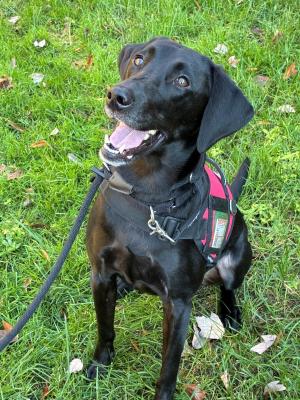
Kayla was diagnosed with Type 1 diabetes (once known as juvenile diabetes) at the age of 17. Monitoring her blood sugar level is critical and fluctuations can affect all parts of life.
She found out about diabetic alert dogs shortly after she was diagnosed through her college best friend. Her family’s research found the Ron and Vicki Santo Diabetic Alert Dog Foundation near Phoenix, Arizona.
“It’s expensive,” Kayla said as Darby lay at her feet. “Insurance doesn’t cover it even though the ADA (Americans with Disabilities Act) considers him medical equipment. Insurance doesn’t consider him to maintain my life. But I found a foundation that assists with finances, and all his supplies are tax deductible."
Kayla was screened by the foundation and eventually picked up Darby during the first week of November two years ago. She traveled to Buckeye, Arizona to pick him up and then started work as an administrative assistant in the Division of Rehabilitation and Reentry on Bush Street a few days later.
Kayla worked with NCDAC to request that Darby be permitted to accompany her to work as a reasonable accommodation. The division worked with Kayla and NCDAC Human Resources to discuss the request and identify how the accommodation could be implemented. Human Resources helped facilitate the process and provide guidance along the way.
That was the start of a learning adventure for Darby and the division.
“This hire was unique,” said Charles Mautz, the Director of Rehabilitation Services who interviewed Kayla. “She didn’t have Darby when we interviewed. We hired her and two weeks later she got Darby.
“We let the entire division know that on this day, you will notice an animal in the office. We were intentional in speaking with any employee who had a fear of large animals, and it was a non-issue. Darby is a fully trained service animal, and not only do we have total respect for him but we are grateful to know he is there. He blends right in, and I forget he’s even here.”
Organizations that train diabetic alert dogs tend to work with labrador retrievers like Darby as they are very intelligent and well-tempered. As the two were on opposite sides of the country, it made it somewhat difficult to bond prior to their meeting. Kayla said she created “scent samples” by soaking cotton balls in her mouth when she had high and low sugar, froze them and overnighted them to Arizona as they had to stay frozen. During training, foundation workers took a cotton ball and gave it to Darby as a reward to get used to a familiar scent.
According to the Santo Foundation, Darby is trained to
• Detect high or low blood sugar levels in people with diabetes—often 15 to 45 minutes before symptoms show or a person’s continuous glucose monitors register a shift.
• Use his acute sense of smell to pick up volatile organic compounds released in human breath and sweat during rapid glucose fluctuations.
• When he senses a dangerous spike or a drop in blood sugar, he is trained to nudge, paw, bark, spin, or howl.
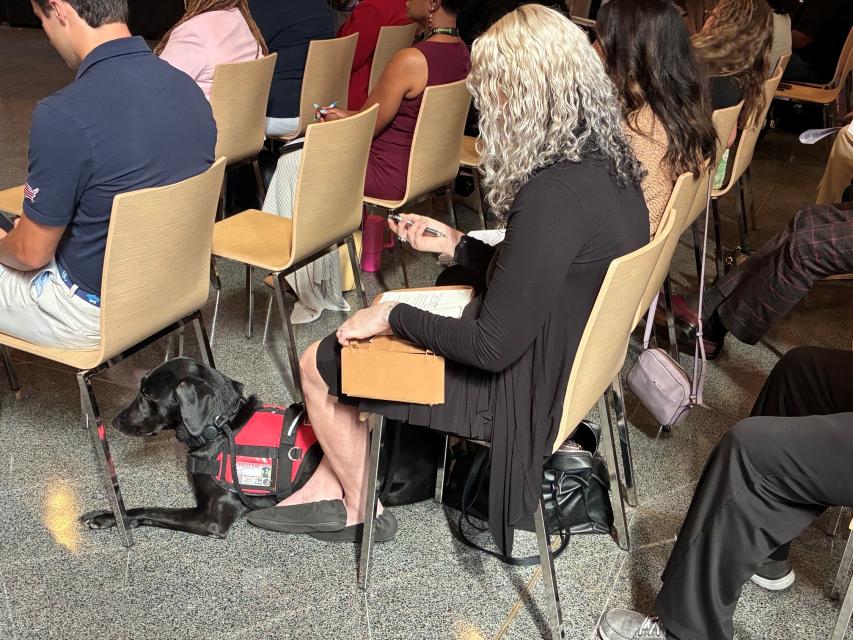
Today, one hardly notices Darby during a meeting. He wears a harness that identifies him as a service dog and quietly lays at Kayla’s feet during a Joint Reentry Council meeting, symposium or during last year’s Rehabilitation and Reentry Conference. He looks lovingly at Kayla and anyone who approaches, but people are reminded not to disturb him unless directed by Kayla.
That includes her new husband, Richard. They dated for about 3 years and married a few weeks ago. Of course, Darby was part of the wedding party.
“I told him if he dated me, he would be around dogs and must love dogs. He and Darby are best friends,” Kayla said.
“I know it has been a major learning curve on Bush Street. Darby was very unsure at first, but he got used to everything. Everyone has been so respectful, wonderful and kind. But one of the biggest things is people think he is emotional support dog because they do not know my disability (at first). It’s important to keep in mind people have diverse needs. Their disability could be invisible. Darby helps me so much.”