
WILMINGTON -- In the North Carolina state correctional system, there’s a group of unsung workers whose roles are incredibly important in the grand scheme of preparing justice-involved people for life outside a prison.
Social workers are the conduit that assist offenders prepare for life after prison. Of the 18,000 people released from state prison each year, about a quarter of those have mental health needs. About 90 days prior to release, social workers contact offenders who are on a mental health caseload.
It’s been shown most people with mental illness are not violent. It takes someone to keep them in treatment to prevent issues from occurring.
Social workers assist by scheduling appointments for housing, transportation, driver licenses/state identification, and mental and physical health. They assist in Medicaid applications and link offenders with local management entities/managed care organizations to receive services for mental health, developmental disabilities or substance use disorders.
And much of this begins with about 90 days left in a person’s sentence.
“Social workers are vital,” said New Hanover Correctional Center Warden Johnny Spearman, whose minimum custody prison is a designated reentry facility. “They help in transition, so the men go out prepared for what they’ll have to deal with. It can be a huge struggle if things are not prepared before they get out. Social workers like Ashley Penny are important.”
Penny is a social worker serving both New Hanover CC and Pender Correctional Institution, a nearby medium custody prison. His social work duties are internal at Pender CI, and he focuses on preparing offenders for post-release at New Hanover CC.
His work at Pender CI involves preparing assessments and treatment plans for inmates enrolled in the day treatment program and assisting in fulfilling accommodation requests for inmates with disabilities.
As part of his work, Penny does aftercare planning at Pender CI as well, but it's usually a smaller caseload than New Hanover CC. The population in Pender’s day treatment program includes many people with intellectual and developmental disabilities and the facility receives more requests for disability accommodation than New Hanover CC.
“Depending on the workload, I have somewhat of a routine,” said Penny, who works to build a rapport with offenders he will work with at both facilities. “I work to set up appointments once offenders leave New Hanover. We come up with a plan and work to make sure he has a place to stay. A lot of what I do is work on an aftercare plan.”
A Morning at New Hanover Correctional Center
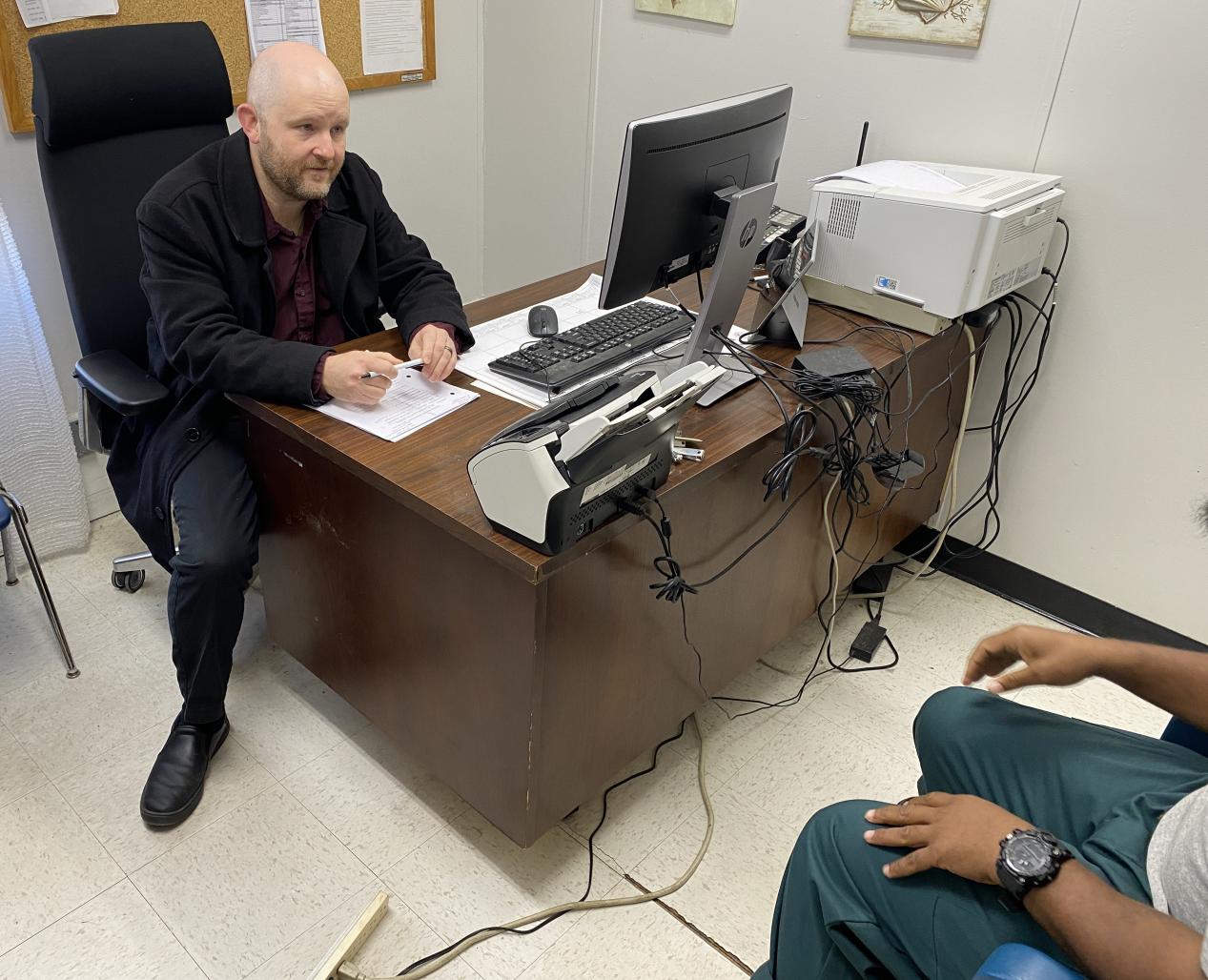
On a sunny Wednesday, Penny prepared for a meeting with an offender due to be released at the end of May.
Preparation is key and Penny was well prepared. He had met with the offender previously and had pages of paperwork partially filled out. That made the meeting run smoothly for both the offender and Penny.
There were questions about the offender’s family, medical, educational and vocational backgrounds and guardianship. Where there were possible stressors the offender would run into once he got out, Penny was ready to schedule meetings with organizations versed in assisting not only formerly justice-involved individuals but also those in the community.
There were Medicaid applications to be filled out and questions about Supplemental Security Income (SSI) from the Social Security Administration. Penny’s calm, cool demeanor helped guide the offender through the questions and, within an hour or so, the answers were written on forms and awaiting Penny’s skills to transcribe on his computer and move forward.
“There is a plan in place, including follow-up mental health appointments,” Penny said. “Continuity of care is very important. If he’s not getting aftercare, what happens after his medication runs out? Counseling is important, as are housing and basic needs.
“This is why case management is very important, too. We work together to find housing and basic needs. We want to prevent a revolving door. We want these men to be good citizens and keep the public safe as well.”
Mary Grillo, the NCDAC Director of Social Work Services, is proud of the work Penny and her staff do. She said it takes special people to serve this population.
“You have to have a heart for the work,” Grillo said. “Ashley is passionate about the work and believes people can change. Part of being a good social worker is being part of the team and building relationships. Ashley has done a good job with that.
“You must be flexible and he is that. You work with the most vulnerable people who are being released. There may be complex medical needs and limited resources. If we can figure out what an offender needs to do to get rehabilitation or transportation, that’s one less major thing they worry about when they get out.”
And much of that worry is eliminated by the great social workers in North Carolina’s prisons.