NCDAC supervises more than 75,000 adults in the community who are on probation, parole or post-release supervision.
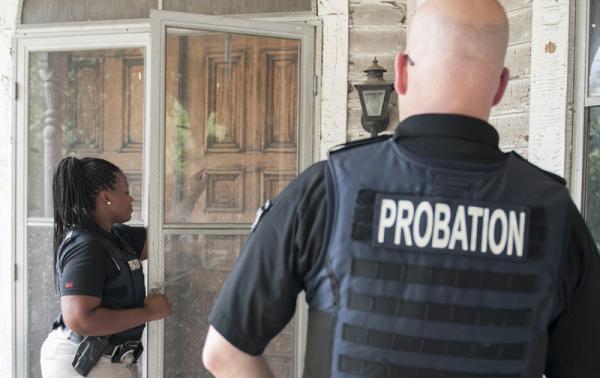
More than 2,000 probation/parole officers are tasked with supervising these individuals and helping to ensure they successfully return to the community after serving their sentences. For more information about the NCDAC Division of Community Supervision and our district offices, click here.
Probation
Probation is a sentence ordered by the court instead of imprisonment that allows the offender to remain in the community as long as the offender follows certain conditions and reports either to the court or to a probation/parole officer. If the offender does not follow the conditions, the court can revoke the probation and impose a sentence of imprisonment in a county jail or state prison. Probation may be supervised by a probation/parole officer or the probation may be unsupervised.
Parole
Parole is the conditional release from prison to community supervision before an offender’s prison sentence is completed. The Post-Release Supervision and Parole Commission has all authority to decide whether or not to release an offender on parole, except for one type of parole called 90-day mandatory parole. Once paroled, the offender is supervised by a Probation/Parole Officer from Community Corrections. If the offender does not abide by the conditions of parole, the Post-Release Supervision and Parole Commission has all authority to send the offender back to prison to continue serving his/her sentence and the offender may or may not be paroled again by the Post-Release Supervision and Parole Commission.
Post-Release Supervision
Post-Release Supervision is similar to parole, except that the offender’s prison sentence is completed and both the date and decision to release an offender on post-release supervision is not made by the Post-Release Supervision and Parole Commission. The offender’s date of release to Post-Release Supervision cannot be changed and is set by sentencing laws. As with parole, an offender released to post-release supervision will be supervised by a Probation/Parole Officer from Community Corrections. If the offender does not abide by the conditions of post-release supervision, the Post-Release Supervision and Parole Commission has all authority to send the offender back to prison for only certain amounts of time, however, the offender must eventually be released.
Probation is a sentence ordered by the court instead of imprisonment that allows the offender to remain in the community as long as the offender follows certain conditions and reports either to the court or to a probation/parole officer. If the offender does not follow the conditions, the court can revoke the probation and impose a sentence of imprisonment in a county jail or state prison.
Supervised probation
This type of probation is ordered by the court and the offender is to be supervised by a probation/parole officer. The probation/parole officer is responsible for monitoring the offender’s adherence to the probation conditions.
Unsupervised probation
This type of probation does not require supervision by a probation/parole officer. The offender will report to the court as directed.
Community Service
Some offenders are ordered to provide service to the community as a condition of their probation. Community Service can be ordered in either supervised or unsupervised probation. DAC is charged with monitoring the offender’s community service hours in both supervised and unsupervised probation cases.
Offenders who are on parole or post-release supervision are supervised under conditions set by the Post-Release Supervision and Parole Commission (the PRSPC). The PRSPC can change the conditions as well as revoke the offender’s parole or post-release supervision for failure to abide by the conditions. Offenders on probation may be subject to the following regular conditions and some may only be changed by the judge or the probation/parole officer may have delegated authority to change or add some conditions.
Regular conditions of probation apply to each defendant placed on supervised probation unless the presiding judge specifically exempts the defendant from one or more of the conditions in open court and in the judgment of the court. It is not necessary for the presiding judge to state each regular condition of probation in open court, but the conditions must be set forth in the judgment. G.S. 15A- 1343(b). The regular conditions of probation are in every circumstance:
- Commit no criminal offense in any jurisdiction.
- Remain within the jurisdiction of the court unless granted written permission to leave by the court or a probation officer.
- Report as directed by the court or his probation officer to the officer at reasonable times and places and in a reasonable manner, permit the officer to visit him at reasonable times, answer all reasonable inquiries by the officer and obtain prior approval from the officer for, and notify the officer of, any change in address or employment.
- Not abscond by willfully avoiding supervision or by willfully making the defendant’s whereabouts unknown to the supervising probation officer. G.S. 15A –1343 (b) (3a).
- Satisfy child support and other family obligations as required by the court. If the courts require the payment of child support, the amount of the payments shall be determined in G.S. 50-13.4(c).
- Possess no firearm, explosive device other deadly weapon listed in G.S. 14-269 without written permission of the court.
- Pay a supervision fee as specified.
- Remain gainfully and suitably employed or faithfully pursue a course of study or of vocational training shall that will equip him for suitable employment.
- Notify the probation officer if offender fails to obtain or retain satisfactory employment.
- Pay any costs and/or fines ordered by the court, and make restitution or reparation as provided in subsection(d).
- Pay the state of North Carolina for the costs of appointed counsel, public defender, or appellate defender to represent him in the case(s) for which he was placed on probation.
- Attend and complete an abuser treatment program if (i) the court finds the defendant is responsible for acts of domestic violence and (ii) there is a program, approved by the Domestic Violence Commission, reasonably available to the defendant, unless the court finds that such would not be in the best interest of justice.
- Submit at reasonable times to warrantless searches by a probation officer of the probationer’s person and of the probationer’s vehicle and premises while the probationer is present, for purposes directly related to the probation supervision, but the probationer may not be required to submit to any other search that would otherwise by unlawful.
- Submit to warrantless searches by a law enforcement officer of the probationer’s person and of the probationer’s vehicle, upon a reasonable suspicion that the probationer is engaged in criminal activity or is in possession of a firearm, explosive device, or other deadly weapon listed in G.S.14-269 without written permission of the court.
- Not use, possess, or control any illegal drug or controlled substance unless it has been prescribed for him or her by a licensed physician and is in the original container with the prescription number affixed on it; not knowingly associate with any known or previously convicted users, possessors, or sellers of any such illegal drugs or controlled substances; and not knowingly be present at or frequent any place where such illegal drugs or controlled substances are sold, kept or used.
- Supply a breath, urine or blood specimen for analysis of the possible presence of prohibited drugs or alcohol when instructed by the defendant’s probation officer for purposes directly related to the probation supervision. If the results of the analysis are positive, the probationer may be required to reimburse the Department of Adult Correction for the actual costs of drug or alcohol screening and testing.
- Waive all rights relating to extradition proceedings if taken into custody outside of North Carolina for failing to comply with the conditions imposed by the court upon a felony conviction. (effective for offenses committed on or after 12/01/16)
- Submit to the taking of digitized photographs, including photographs of the offender’s face, scars, marks, and tattoos, to be included in the probationer’s records. (effective for offenses committed on or after 12/01/16)
Conditions of community supervision may be adjusted to encourage the offender to continue with good behavior or to penalize the offender for bad behavior. Whom may adjust the conditions is dependent on a number of factors.
Parole reviews are conducted by the Post-Release Supervision and Parole Commission (PRSPC) for consideration of a conditional release from prison to community supervision before an offender’s sentence is complete. A parole review is not the same thing as a custody review, for more information see the Custody review vs Parole review section.
- Not all offenders are eligible to be paroled.
- Most offenders are not eligible to be paroled if they committed the crime after 10/1/1994.
- To find out if an offender is eligible for parole, please contact VSSPPP staff at 1-866-719-0108.
- Parole reviews are conducted annually or every 2 or 3 years depending on the crime.
- Parole is earned and not automatic.
- Parole provides an opportunity for the offender to live in the community supervised by a probation/parole officer and, if the offender cannot abide by the conditions set by the PRSPC, the parole laws permit the PRSPC to return the inmate to prison to continue serving their sentence (revoke parole).
- A victim’s input is an important part of the information that the PRSPC considers when deciding to parole and offender. Written input may be provided by victims at any time by writing to:
NCDAC Victim Support Services
4223 Mail Service Center
Raleigh, NC 27699-4200
- A victim can call 919-716-3010 four months prior to the parole review date to schedule a parole meeting.
- Up to five people can attend the parole meeting, which last 30 minutes, and attendees will need to bring a picture ID with them.
- The parole meeting is with one Commissioner and the offender will not be present.
Notifications about parole reviews are provided only if you are registered with VSSPPP to receive notifications. NCSAVAN does not provide notifications about parole reviews.
A custody review is not the same thing as a parole review. Often times victims who use the DAC Offender Search tool will see the date for the next custody review and assume that this is the date an offender is going to be reviewed for parole. This is not the case.
Custody reviews are conducted routinely every six months by Prisons staff for all offenders to address security and behavior of the offenders in state prisons. Offenders remain housed in a state prison.
- Prison Administration is charged with managing offenders. One way in which Prisons does this is through the assignment of offenders to custody levels.
- Custody classification is a determination of how much security will be needed to ensure offenders remain safely confined and/or managed. The custody classification level depends on the seriousness of the crime, willingness of the offender to obey rules and regulations, and perceived potential for attempting escape. See the Prison custody classifications (close, medium, minimum) section.
- While information from victims is helpful information for Prisons staff, victims cannot prevent the routine review of an offender’s custody level nor the promotion or demotion in custody level. In addition, custody levels are not an indicator of a release date. Release dates are determined by sentencing laws. Custody reviews occur regularly and separately from parole reviews. And, Parole is only applicable if the offender committed their crime before 10/1/1994; otherwise, an offender's minimum release date is pre-determined and cannot be changed except by the courts.
Notifications about custody reviews are not provided.
Parole reviews, unlike custody reviews, are conducted by the Post-Release Supervision and Parole Commission (PRSPC) for consideration of a conditional release from prison to live in the community and be supervised by a probation/parole officer before an offender’s sentence is complete.
- Not all offenders are eligible to be paroled.
- Most offenders are not eligible to be paroled if the they committed the crime after 10/1/1994.
- To find out if an offender is eligible for parole, please contact VSSPPP staff at 1-866-719-0108.
- Parole reviews are conducted annually or every two or three years depending on the crime.
- Parole is earned and is not automatic.
- Parole provides an opportunity for the offender to live in the community supervised by a probation/parole officer and if the offender cannot abide by the conditions set by the PRSPC, parole laws permit the PRSPC to return the offender to prison to continue serving their sentence (revoke parole).
- A victim’s input is an important part of the information that the PRSPC considers when deciding to parole an offender. Written input may be provided by victims at any time by writing to:
NCDAC Victim Support Services
4223 Mail Service Center
Raleigh, NC 27699-4200
- A victim can call 919-716-3010 four months prior to the parole review date to schedule a parole meeting.
- Up to five people can attend the parole meeting, which last 30 minutes, and you will need to bring a picture ID with you.
- The parole meeting is with one Commissioner and the offender will not be present.
Notifications about parole reviews are provided only if you are registered with VSS to receive notifications. NCSAVAN does not provide notifications about parole reviews.
When would an offender be moved to a prison out of state?
- North Carolina is a participating member of the Interstate Corrections Compact agreement. For an offender to transfer from North Carolina to a specific state or to North Carolina from another state, N.C. and the other state must have an agreement or contract in place. N.C. has many partner states as well as being in an agreement with the Federal Bureau of Prisons.
- Despite North Carolina being a participant in the I.C.C., no offender from our state or another wishing to transfer to N.C. is entitled to participate in the program.
- Generally, transfers as a part of the I.C.C. must meet at least one of the following conditions:
- To provide for the personal safety of an offender subject to an identifiable threat of harm after consideration of all available housing alternatives.
- To provide for effective pre-release program assignments for offenders in minimum or medium custody within three years of an established release date at the time of transfer.
- In any case where the secretary of the Department of Adult Correction issues a finding that such a transfer is in the best interest of the state of North Carolina, the Department, the offender and criminal justice objectives. This category could include instances where the offender does not have family in the state they are currently incarcerated in.
When would an offender on community supervision move to another state?
- If an offender on community supervision requests to be supervised by another state, they may be allowed to under the Interstate Commission for Adult Offender Supervision Compact.
- For more information regarding the transfer of offenders on probation, parole or post-release supervision, click here to visit our Community Supervision webpage with Information About Interstate Compact Transfers
Victims may contact VSS for more information about offenders who are transferred to another state.
The North Carolina Post Release Supervision & Parole Commission is an independent agency responsible for releasing offenders who meet eligibility requirements established in North Carolina General Statutes.
In 1994, the N.C. General Assembly enacted Structured Sentencing, which eliminates parole. However, the Commission establishes conditions of post-release supervision for felons convicted under the Structured Sentencing Act. The Commission does not hold formal hearings and does not meet personally with offenders when reviewing cases for possible parole. Each case is reviewed on an individual basis since each has its own characteristics.
Click here to visit our NC Post Release Supervision and Parole Commission webpages for information about their members, processes, media notifications, and how you can support or oppose parole for an offender.